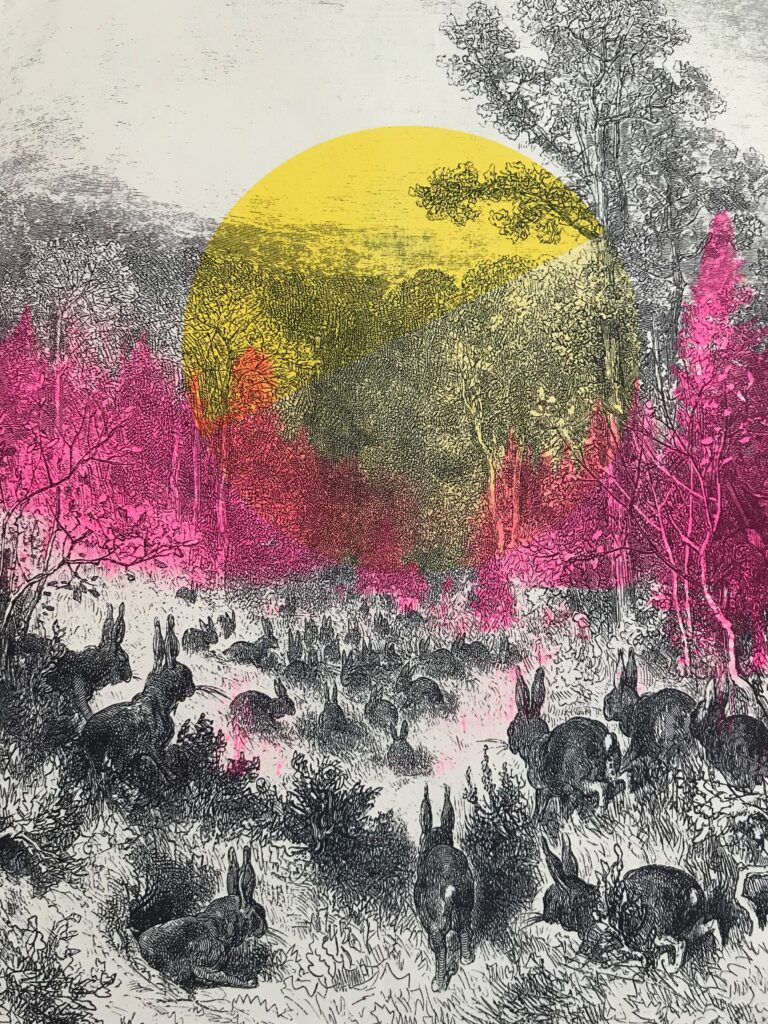
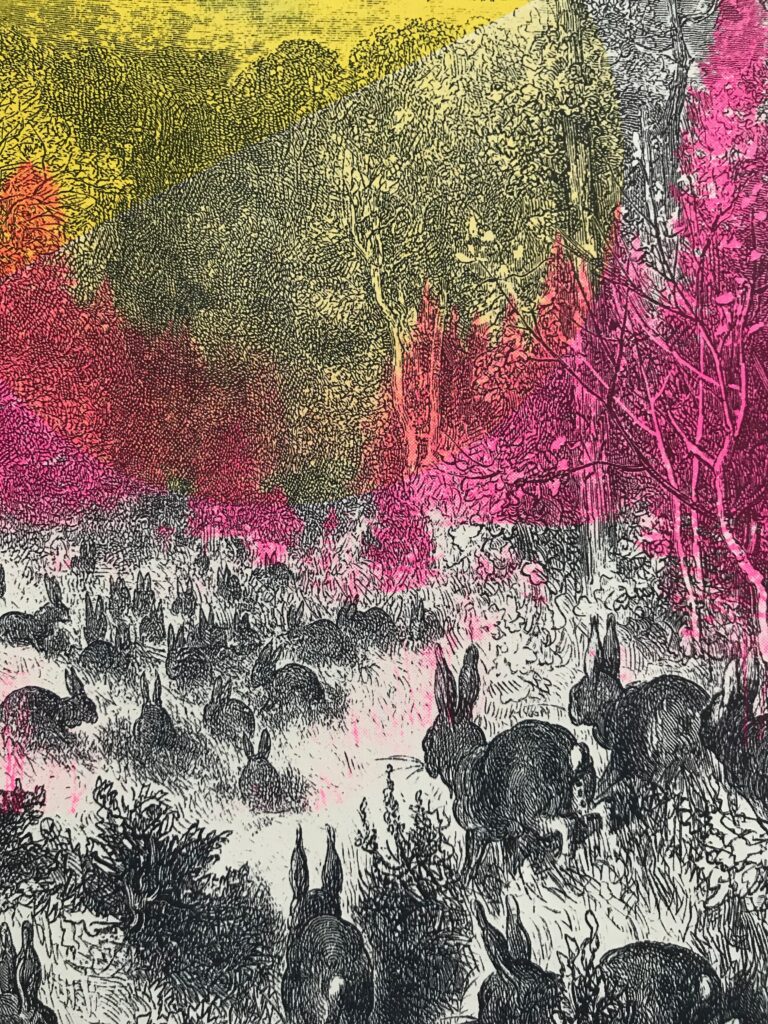
Experimentation around the notions of hybridity and programmed random practices.
The image used is a woodcut by Gustave Doré, from a collection of La Fontaine’s Fables published in 1867.
The hybridity comes from the variety of printing mediums, some very old and some contemporary, combined to compose this image, but also from the alloying of several images, whose meeting was unpredictable, “[beautiful] like the chance meeting on a dissection table of a sewing machine and an umbrella.” (The Songs of Maldoror by Isidore Ducasse, known as the Count of Lautréamont, 1867)
This one was printed in risography in night blue in 10 copies, on a series of sheets which already included each one a series of patterns superimposed in a random way.
Indeed, we systematically keep several versions of each image or printed text in order to associate them and to provoke an intertextual richness in each final image, which is unique despite the large-scale reproduction process used, thus nourishing a programmed random approach. In the example above, the engraving illustrating La Fontaine’s fable “The Rabbits” is superimposed on a photograph of a snowy Quebec landscape (in pink), and on a purely graphic element, a yellow circle declined under two levels of transparency.
The superimposition of yellow and pink adds an orange motif in places. Each print in the series is different, mixing other texts and other images in a new palimpsest.